Level crossing with inno and B kerbstone installed in just three hours
Facts
- Location: Sachsel – Giswil, Switzerland
- Period: March 2020
- Client: Zentralbahn ZB
- Products: B kerbstones, inno inner and outer panels
- Length/quantity: 5.40 m
- Conditions: SBB I rails, VÖV EM 2 sleepers
Advantages
- No precast foundations
- No excavation of gravel and intervention in the substructure
- No levelling layer required
- Quick and simple installation, reducing closure times
Project description
Every hour that a track or road remains closed incurs significant logistical and economic costs. For this project, the challenge was not only to install a 5.4-meter-long level crossing quickly but also to make it immediately passable once installation was complete. Conventional construction methods, which require curing times for concrete foundations, were therefore ruled out from the start.
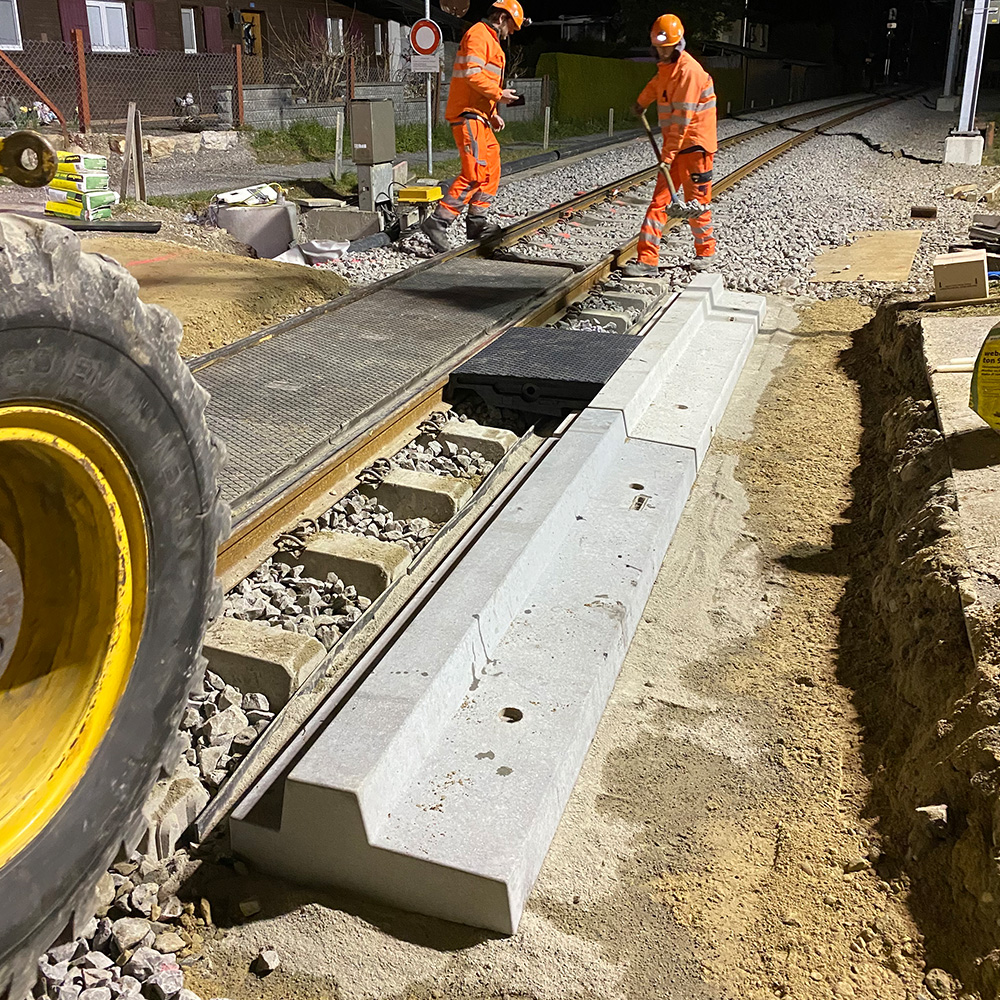
The project managers chose an innovative, time-saving solution from KRAIBURG STRAIL. The inno level crossing system served as the foundation, enabling fast and flexible installation thanks to its independence from sleeper spacing. The real time-saver, however, was the combination with the specially designed kerbstones.
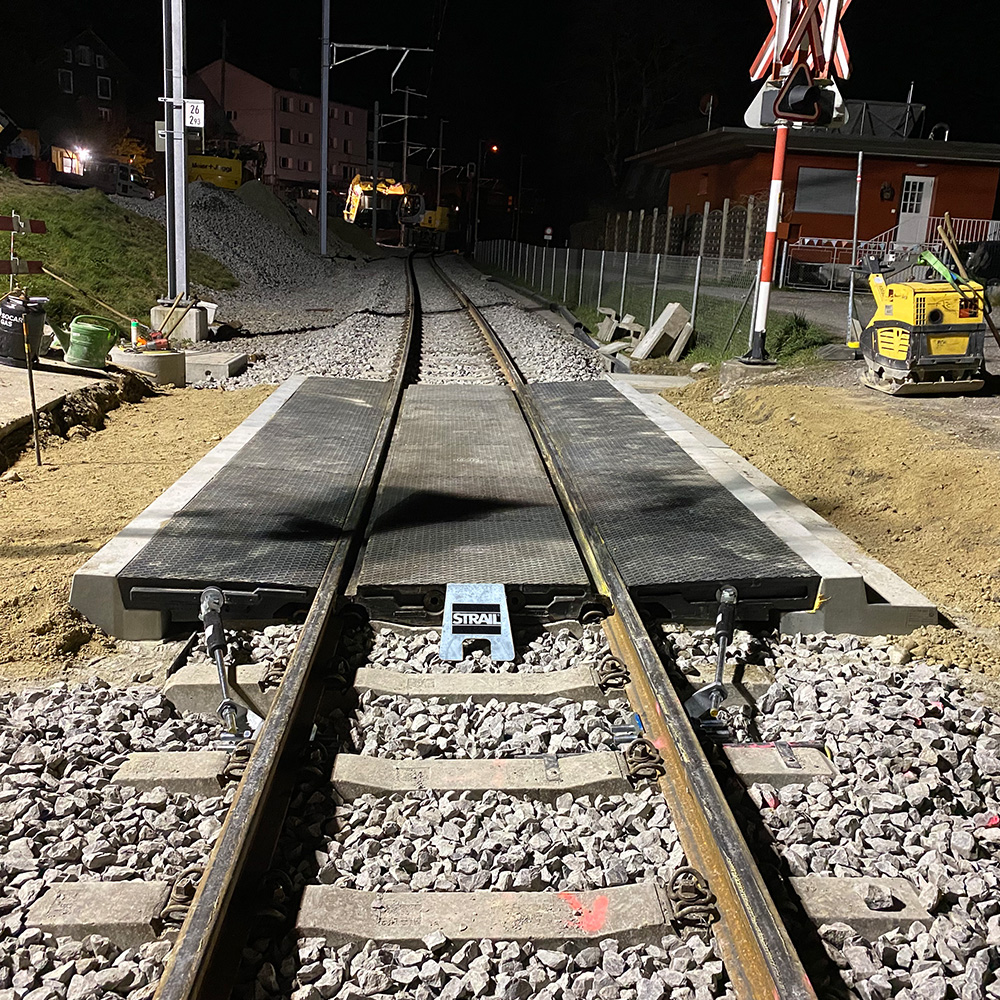
These kerbstones require no precast foundation. By eliminating the need for concrete casting, the associated curing time is completely avoided—resulting in a significant reduction in construction time. The installation itself was executed with high professionalism by the railway construction company Meier + Jäggi AG. With a team of just four people, the entire level crossing—including all kerbstones and inner and outer panels—was installed in only three hours.
The combination of the inno system and the B kerbstone ensured maximum efficiency. Not only was the level crossing installed in record time, but thanks to the B kerbstone, it could be reopened to road traffic immediately after completion. This project demonstrates that KRAIBURG STRAIL’s innovative solutions deliver fast, safe, and fully operational infrastructure—even under the tightest time constraints.